A small Northern California district paired the right curriculum with the right support and built the leadership capacity to make it stick
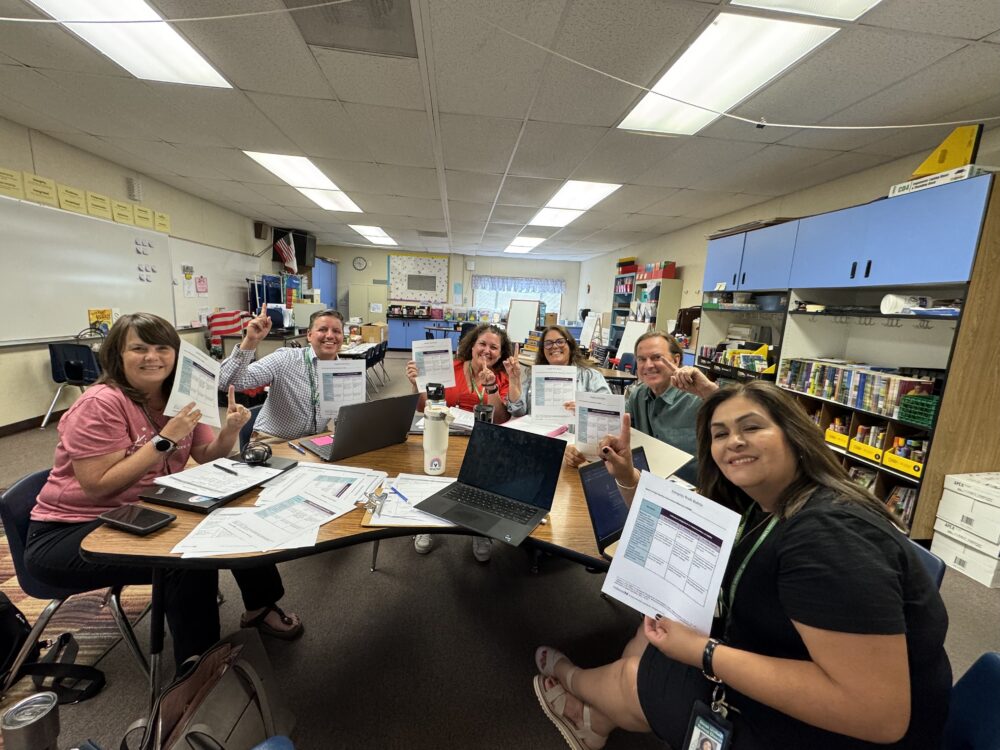
Dixon Unified School District (DUSD) sits halfway between the San Francisco Bay Area and Sacramento. It’s a district of 2,905 students across six schools where 61.7% are Hispanic/Latino and 67.1% are economically disadvantaged [Internal District Data, 2026]. Like many districts, DUSD reached a familiar crossroads: its math curriculum was no longer keeping pace with shifts in mathematical practice and instruction. There was a groundswell of agreement that it was time for something new. What DUSD’s leaders understood was that adopting a new curriculum is only the beginning. “It’s how you use it in classrooms, that’s really most of the work,” said Superintendent Brett Barley.
To do that work well, DUSD built an innovative two-pronged partnership with UnboundEd and Amplify. UnboundEd would focus on developing leaders, and Amplify, the publisher of the district’s newly adopted curriculum, Amplify Desmos Math, would focus on supporting teachers, given its expertise in the curriculum. The strength of this approach lies in the collective efficacy of partnership: by working closely together, DUSD, UnboundEd, and Amplify provide aligned professional learning across every layer of the system, laying the groundwork for sustained implementation.
A Curriculum Chosen, Not Imposed
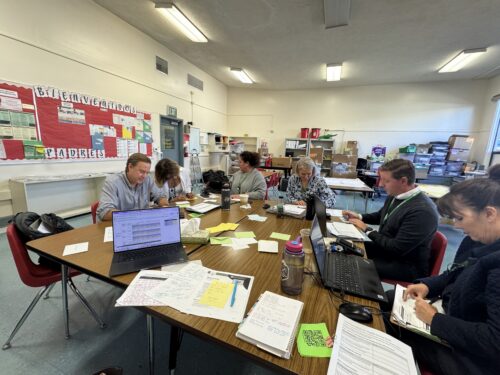
In the fall of 2024, a cross-functional district implementation team of approximately six leaders partnered with UnboundEd to lead the curriculum adoption process. They first established a shared vision for mathematics instruction, then identified district “non-negotiables” and developed a quality review rubric to ensure that only curricula aligned with that vision were considered. The team narrowed the field to four or five programs it deemed high quality, drawing on evidence from independent reviewers such as EdReports.
“We didn’t enter into the curriculum adoption space with our teachers feeling like we [administrators] needed to put our finger on the scale in any shape or form,” Barley explained. Teachers and the selection committee ultimately chose Amplify Desmos Math. DUSD’s teachers were genuinely excited about the opportunities for student discourse and the supports that Amplify Desmos Math included for Multilingual Learners (MLs). That excitement carried into the school year, generating the buy-in that so many implementations lack.
Two Partners, One Coherent Message
DUSD’s design brought two outside partners into coherence rather than letting them work at cross-purposes. UnboundEd focused on supporting leaders and systems, while Amplify provided the curriculum and coaching resources that helped teachers and guided the coaches overseeing implementation. To keep everything running smoothly, DUSD hired Cristin Fiorelli as Executive Director of Educational Services to serve as what Barley called “the connective tissue” of the partnership.
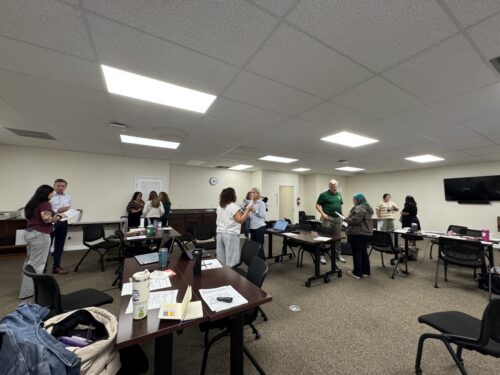
The team established a standing monthly meeting for everyone to align on what teachers would experience. “We obviously just didn’t want to duplicate efforts,” Fiorelli said. “We wanted to make sure what our instructional coaches were doing in front of teachers, as guided by the UnboundEd work, was not at cross-purposes with the things that Amplify were doing.” Through the partnership, the team aligned on the tools, coaching focus areas, and sequence, drawing on both UnboundEd’s leadership support and Amplify Desmos Math’s high-quality curriculum and coaching resources so that whatever reached teachers “felt very coherent and cohesive to them.”
Professional Learning Built With DUSD and for DUSD
Barley and Fiorelli describe the professional learning as “bespoke.” Rather than pulling professional learning sessions off the shelf, DUSD’s leaders, Amplify, and UnboundEd worked side by side throughout the implementation. Members of both partner teams joined regular learning walks in schools, then came together afterward with district leaders to debrief what they saw, identify root causes, and plan next steps. Those conversations shaped the next round of professional learning, so the support teachers received was always grounded in what was actually happening in classrooms.
“More often than not, you get the professional development that is just curated off the shelf,” Barley said. “This was different… It was, let’s write this training and professional development together, and then deliver it.” In one case, the team identified lesson planning as a key area of need. UnboundEd worked with district leaders to develop a planning tool tailored to the specific gaps they had observed and coached principals and instructional coaches on how to use it in small-group professional learning. UnboundEd also coordinated closely with Amplify, ensuring Amplify’s team was familiar with the tool and shifting the focus of an upcoming Amplify training to unit planning so that the support from both partners reinforced one another. “It wasn’t just, ‘Here’s a planning tool,’” Fiorelli recalled. “It was, ‘What exactly did we see that were the deficits in planning, and how should we craft this tool to make sure it meets the Dixon teacher’s needs?’”

Evidence That It’s Working
The clearest sign of change is also the most fundamental. Before implementation, Barley said that leaders walking into classrooms “would see teachers frequently not using the district-adopted curriculum,” defaulting instead to materials pulled from the internet or to putting students in front of a screen. “Now we see 100% curriculum usage when we come in for math instruction.” That shift, he argued, clearly demonstrates teacher confidence that the curriculum is “a worthy tool and worthy materials to be putting in front of kids.”
At the leadership level, the change is just as concrete. Every principal and instructional coach now conducts targeted 15-minute math observations six to eight times a month, using a shared rubric to gauge teacher practice on specific domains such as pacing, student engagement, and academic discourse. “We wouldn’t even have known what to look for going in last year,” Fiorelli said. “Those kinds of conversations are happening now.”
Barley pinpointed the moment it clicked for him. “I used to be the toughest rater of implementation during our classroom walkthroughs. Then one day, I realized my colleagues were seeing the same strengths and growth areas I had been noticing, plus others I had not. That’s when it clicked that we’d become calibrated around a shared vision for high-quality instruction.”
What Made It Work — and What Comes Next
Reflecting on the success of the initiative, Barley pointed to vertical alignment, made possible by the deep, sustained, and intentional collaboration among DUSD, Amplify, and UnboundEd, as the key: a superintendent, an executive director, and every site principal doing the work together. “When teachers see… that level of investment of time and energy from these particular people, it sends a message and a signal that we’re serious about this work.”
In the 2026–2027 school year, the district is building on its momentum with a continued focus on high-quality mathematics instruction and on ensuring every student has access to rigorous, grade-level learning. For the second year in a row, DUSD will partner with both UnboundEd and Amplify to continue strengthening its implementation of Amplify Desmos Math, a high-quality, purposeful curriculum, via coordinated instructional support, professional learning, and coaching for teachers and leaders.
For Fiorelli, that’s the key to sustaining the work. Reaching that goal, she noted, is “100% contingent upon the instructional support, professional learning, and coaching we give” teachers.
The forward-looking goal is, fittingly, independence. “Eventually, we know we need to put UnboundEd out of their job, because we have internalized these skills and abilities within the district,” Barley said. “We need to build our internal capacity so that we can lead the work.”
UnboundEd + Amplify
UnboundEd is partnering with Amplify to achieve lasting impact through effective HQIM implementation and the development of sustainable instructional practices. Amplify’s deep expertise in Amplify Desmos Math and program-aligned professional learning, combined with UnboundEd’s proven strengths in change management, instructional transformation, and leadership coaching, means that this partnership delivers enduring changes in instructional methods with potent, long-term effects.


Curriculum Adoption
Ensuring quality materials are adopted and used effectively is crucial to improving outcomes and requires a strong instructional materials selection process. We’re here to share guidance and support on leading a rigorous and collaborative curriculum adoption process to select the right materials for your context and goals.

Curriculum Implementation
Whether you’re just getting started with a new curriculum or need to get implementation back on track, we work shoulder-to-shoulder with you to build a shared vision, an actionable plan, and the systems necessary for your success.